Can Eating Before a Dna Test Mess It Up
DNA paternity testing is the use of Dna profiles to make up one's mind whether an individual is the biological parent of another private. Paternity testing tin be especially of import when the rights and duties of the father are in event and a child's paternity is in doubtfulness. Tests can besides decide the likelihood of someone being a biological grandparent. Though genetic testing is the most reliable standard, older methods also exist, including ABO blood group typing, analysis of diverse other proteins and enzymes, or using human being leukocyte antigen antigens. The current techniques for paternity testing are using polymerase concatenation reaction (PCR) and restriction fragment length polymorphism (RFLP). Paternity testing can now also be performed while the woman is still pregnant from a blood draw.[1] [two]
DNA testing is currently the near advanced and accurate technology to determine parentage. In a DNA paternity test, the result (chosen the 'probability of parentage)[3] [ failed verification ] is 0% when the alleged parent is not biologically related to the kid, and the probability of parentage is typically 99.99% when the alleged parent is biologically related to the kid. Withal, while almost all individuals have a single and singled-out set of genes, rare individuals, known as "chimeras", have at least two unlike sets of genes, which can result in a fake negative result if their reproductive tissue has a unlike genetic make-upwardly from the tissue sampled for the examination.[4]
Paternity or maternity testing for kid or developed [edit]
The Deoxyribonucleic acid exam is performed by collecting buccal (cheek) cells plant on the inside of a person's cheek using a buccal or cheek swab. These swabs have wooden or plastic stick handles with a cotton on synthetic tip. The collector rubs the within of a person'south cheek to collect as many buccal cells as possible, which are then sent to a laboratory for testing. Samples from the alleged begetter or mother and the kid would exist needed.
Prenatal paternity testing for unborn child [edit]
Invasive prenatal paternity testing [edit]
It is possible to determine who the biological father of the fetus is while the woman is still pregnant through procedures called chorionic villus sampling or amniocentesis. Chorionic villus sampling retrieves placental tissue in either a transcervical or transabdominal way. Amniocentesis retrieves amniotic fluid by inserting a needle through the pregnant female parent'southward abdominal wall. These procedures are highly accurate because they are taking a sample direct from the fetus; nevertheless, there is a small risk for the woman to miscarry and lose the pregnancy as a result. Both CVS and Amnio require the pregnant woman to visit a genetic specialist known as a maternal fetal medicine specialist who will perform the procedure.
Non-invasive prenatal paternity testing [edit]
Advances in genetic testing accept led to the ability to place the biological begetter while the woman is withal pregnant. There is a small-scale amount of fetal Dna (cffDNA) present in the mother's blood during pregnancy. This allows for accurate fetal DNA paternity testing during pregnancy from a blood depict with no risk of miscarriage. Studies take shown that cffDNA can first be observed every bit early as 7 weeks gestation, and the amount of cffDNA increases as the pregnancy progresses.[5] [6]
DNA profiling [edit]
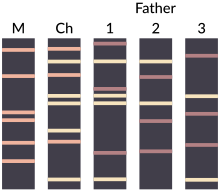
Instance of Dna profiling in lodge to determine the father of a child (Ch). Child's DNA sample should contain a mixture of different size Dna bands of both parents. In this instance person #1 is likely the male parent
The Deoxyribonucleic acid of an individual is the same in every somatic (nonreproductive) cell. Sexual reproduction brings the DNA of both parents together to create a unique combination of genetic fabric in a new cell, so the genetic cloth of an individual is derived from the genetic fabric of each parent in equal amounts; this genetic fabric is known as the nuclear genome of the individual, because it is found in the nucleus.
Comparison the DNA sequence of one person to that of another tin bear witness if i of them was derived from the other, merely DNA paternity tests are not currently 100% accurate. Specific sequences are examined to see if they were copied verbatim from 1 individual'southward genome; if so, and so the genetic material of ane individual could accept been derived from that of the other (i.e. one is the parent of the other). Besides nuclear Deoxyribonucleic acid, mitochondria as well accept their own genetic material called mitochondrial DNA. Mitochondrial DNA comes simply from the mother, without whatever shuffling.
Proving a relationship based on comparing of the mitochondrial genome is much easier than that based on the nuclear genome. Withal, testing the mitochondrial genome tin can prove but if two individuals are related by mutual descent through maternal lines only from a common ancestor and is, thus, of limited value (i.e., it could not be used to examination for paternity).
In testing the paternity of a male child, comparison of the Y chromosome can be used, since it is passed direct from male parent to son.
In the United states, the AABB has regulations for Dna paternity and family relationship testing, but AABB accreditation is not required. DNA exam results are legally admissible if the collection and the processing follows a chain of custody. Similarly in Canada, the SCC has regulations on Deoxyribonucleic acid paternity and relationship testing, simply this accreditation, while recommended, is not required.
The Paternity Testing Committee of the International Gild for Forensic Genetics has taken up the chore of establishing the biostatistical recommendations in accordance with the ISO/IEC 17025 standards.[7] Bio-statistical evaluations of paternity should be based on a likelihood ratio principle - yielding the Paternity Index, PI. The recommendations provide guidance on concepts of genetic hypotheses and calculation concerns needed to produce valid PIs, as well every bit on specific issues related to population genetics.
History [edit]
The get-go class of whatsoever kind of parental testing was blood typing, or matching blood types between the child and declared parent, which became available in the 1920s, after scientists recognized that blood types, which had been discovered in the early 1900s, were genetically inherited. Under this form of testing, the claret types of the child and parents are compared, and it can be determined whether there is whatever possibility of a parental link. For example, two O blood type parents can produce a child simply with an O blood type, and ii parents with a B blood blazon tin can produce a child with either a B or an O blood blazon. This often led to inconclusive results, as 30% of the entire population tin can be excluded from being the possible parent under this form of testing.[8] In the 1930s, serological testing, which tests certain proteins in the blood, became bachelor, with a 40% exclusion rate.[9]
In the 1960s, highly accurate genetic paternity testing became a possibility when HLA typing was developed, which compares the genetic fingerprints on white blood cells between the kid and alleged parent.[ten] HLA tests could be done with 80% accuracy but could not distinguish betwixt close relatives.[eleven] Genetic parental testing technology advanced further with the isolation of the first restriction enzyme in 1970. Highly accurate DNA parental testing became available in the 1980s with the development of RFLP. In the 1990s, PCR became the standard method for DNA parental testing: a simpler, faster, and more accurate method of testing than RFLP, it has an exclusion rate of 99.99% or college.[xi]
Legal evidence [edit]
The DNA parentage exam that follows strict concatenation of custody can generate legally admissible results that are used for child support, inheritance, social welfare benefits, immigration, or adoption purposes. To satisfy the chain-of-custody legal requirements, all tested parties take to exist properly identified and their specimens collected by a third-political party professional who is non related to whatsoever of the tested parties and has no involvement in the outcome of the test.
The quantum of evidence needed is clear and convincing evidence: that is, more show than an ordinary example in civil litigation, but less than beyond a reasonable doubt required to captive a defendant in a criminal case.
In recent years, immigration authorities in various countries, such as the U.s.a., Uk, Canada, Commonwealth of australia, France, and others, may take Deoxyribonucleic acid parentage test results from immigration petitioners and beneficiaries in a family unit-based clearing case when primary documents that bear witness biological relationship are missing or inadequate.
In the U.South., immigration applicants conduct the responsibility of arranging and paying for Dna testing. The U.South. clearing authorities require that the Dna test, if pursued, be performed past one of the laboratories accredited by the AABB (formerly American Association of Blood Banks). Similarly, in Canada, the laboratory needs to be accredited by the Standards Council of Canada.
Although paternity tests are more common than maternity tests, there may be circumstances in which the biological mother of the child is unclear: examples include cases of an adopted child attempting to reunify with his or her biological mother, potential hospital mix-ups, and in vitro fertilization where the laboratory may take implanted an unrelated embryo within the female parent.
Other factors, such as new laws regarding reproductive technologies using donated eggs and sperm and surrogate mothers, tin can besides mean that the female giving birth is not necessarily the legal female parent of the child. For instance, in Canada, the federal Human Assisted Reproduction Act provides for the use of hired surrogate mothers. The legal mother of the child may be the egg donor. Like laws are in place in the United Kingdom and Australia.
In Brazil in 2019, 2 male identical twins were ordered to both pay maintenance for a child fathered past one of them, because the father could not be identified with Deoxyribonucleic acid.[12]
Legal issues [edit]
Australia [edit]
Peace-of-listen parentage tests are widely bachelor on the net. For a parentage test (paternity or maternity) to be admissible for legal purposes, such as for changing a nascency certificate, Family Constabulary Court proceedings, visa/citizenship applications or kid back up claims, the procedure must comply with the Family Law Regulations 1984 (Cth).[13] Further, the laboratory processing the samples must be accredited by the National Association of Testing Authorities (NATA).[14]
Canada [edit]
Personal paternity-testing kits are bachelor. The Standards Quango of Canada regulates paternity testing in Canada whereby laboratories are ISO 17025-approved. In Canada, but a handful of labs have this approval, and it is recommended that testing is performed in these labs. Courts also have the power to order paternity tests during divorce cases.[15]
People's republic of china [edit]
In China, paternity testing is legally available to fathers who suspect their child is non theirs. Chinese law also requires a paternity examination for any child born outside the one-child policy for the child to exist eligible for a hukou, or family registration record. Family tie formed past adoption can also only exist confirmed past a paternity test. A large number of Chinese citizens seek paternity testing each year, and this has given rise to many unlicensed illegal testing centers being ready.[16]
France [edit]
DNA paternity testing is solely performed on decision of a judge in case of a judiciary procedure in order either to found or contest paternity or to obtain or deny child support.[17] Individual Deoxyribonucleic acid paternity testing is illegal, including through laboratories in other countries, and is punishable by upward to a twelvemonth in prison and a €fifteen,000 fine.[eighteen] The French Council of State has described the police force's purpose as upholding the "French government of filiation" and preserving "the peace of families."[19]
Frg [edit]
Under the Gene Diagnostics Act of 2009, hole-and-corner paternity testing is illegal. Whatever paternity testing must be conducted past a licensed dr. or by an proficient with a academy caste in science and special education in parentage testing, and the laboratory carrying out genetic testing must be accredited according to ISO/IEC 17025. Full informed consent of both parents is required, and prenatal paternity testing is prohibited, with the exception of sexual abuse and rape cases. Any genetic testing done without the other parent's consent is punishable with a €5,000 fine.[20] Due to an subpoena of the civil law section 1598a in 2005, any man who contests paternity no longer automatically severs legal rights and obligations to the child.[21] [22]
Israel [edit]
A paternity test with any legal continuing must exist ordered past a family courtroom. Though parents accept admission to "peace of mind" parental tests through overseas laboratories, family courts are under no obligation to have them as show. It is also illegal to take genetic cloth for a parental test from a small over 16 years of age without the minor'southward consent. Family courts have the power to order paternity tests confronting the will of the male parent in divorce and child support cases, as well as in other cases such as determining heirs and settling the question involving the population registry. A man seeking to prove that he is not the begetter of the child registered as his is entitled to a paternity test, even if the female parent and natural guardian object. Paternity tests are not ordered when information technology is believed it could lead to the murder of the female parent, and until 2007, were not ordered when in that location was a take a chance that the child could have been conceived outside of union, making them a mamzer under Jewish law.[23] [24] [25]
Philippines [edit]
Dna paternity testing for personal knowledge is legal, and domicile test kits are available by mail from representatives of AABB- and ISO 17025-certified laboratories.[26] DNA Paternity Testing for official purposes, such as sustento (child support) and inheritance disputes, must follow the Rule on Dna Bear witness A.M. No. 06-11-5-SC, which was promulgated by the Philippine Supreme Court on October 15, 2007.[27] Tests are sometimes ordered past courts when proof of paternity is required.
Spain [edit]
In Spain, peace-of-heed paternity tests are a "large business organisation," partly due to the French ban on paternity testing, with many genetic testing companies being based in Spain.[28] [29]
United Kingdom [edit]
In the United Kingdom, there were no restrictions on paternity tests until the Homo Tissue Act 2004 came into force in September 2006. Section 45 states that it is an offence to possess without appropriate consent whatsoever homo bodily material with the intent of analysing its Dna. Legally declared fathers have access to paternity-testing services under the new regulations, provided the putative parental Dna being tested is their own. Tests are sometimes ordered by courts when proof of paternity is required. In the United kingdom of great britain and northern ireland, the Ministry of Justice accredits bodies that tin conduct this testing. The Department of Health produced a voluntary code of practice on genetic paternity testing in 2001. This document is currently under review, and responsibility for it has been transferred to the Human being Tissue Authority. In the 2022 instance of Anderson 5 Spencer the Court of Appeal permitted for the very first fourth dimension DNA samples taken from a Deceased person to exist used for paternity testing.
U.s.a. [edit]
In the United States, paternity testing is fully legal, and fathers may test their children without the consent or noesis of the mother. Paternity testing take-home kits are readily available for buy, though their results are not open-door in court and are for personal knowledge only.
Only a court-ordered paternity test may be used as evidence in court proceedings. If parental testing is being submitted for legal purposes, including immigration, testing must be ordered through a lab that has AABB accreditation for relationship DNA testing.[30]
The legal implications of a parentage result test vary by state and co-ordinate to whether the putative parents are unmarried or married. If a parentage test does not meet forensic standards for the land in question, a courtroom-ordered test may be required for the results of the examination to be admissible for legal purposes. For single parents, if a parent is currently receiving child support or custody, but DNA testing later proves that the human is non the begetter, support automatically stops. Notwithstanding, in many states, this testing must be performed during a narrow window of time, if a voluntary acknowledgement of parentage form has already been signed by the putative father; otherwise, the results of the test may exist disregarded by law, and in many cases, a man may be required to pay child back up, though the child is biologically unrelated. In a few states, if the mother is receiving the support, and so that alleged father has the right to file a lawsuit to get dorsum any money that he lost from paying back up. Equally of 2011, in most states, unwed parents confronted with a voluntary acknowledgement of parentage form are informed of the possibility and right to asking a Dna paternity examination. If testing is refused past the mother, the father may not be required to sign the nascency document or the voluntary acknowledgement of parentage grade for the child. For wedded putative parents, the married man of the mother is presumed to exist the father of the child. But, in virtually states, this presumption can be overturned by the application of a forensic paternity test; in many states, the fourth dimension for overturning this presumption may be limited to the first few years of the child's life.
Opposite paternity testing [edit]
Opposite paternity decision is the ability to establish the biological father when the begetter of that person is not available. The test uses the STR alleles in the mother and her child, other children and brothers of the alleged father, and deduction of genetic constitution of the male parent by the basis of genetic laws, all to create a rough amalgamation. This tin can compare the father'south Dna when a direct sample of the father'due south Dna is unavailable. An episode of Solved shows this examination beingness used to know if a claret sample matches with the victim of a kidnapping.
Run into also [edit]
- Paternity fraud
- Mosaicism and chimerism, rare genetic atmospheric condition that tin can upshot in false negative results on Dna-based tests
- Non-paternity event
- Lauren Lake's Paternity Court, a idiot box series that debuted in autumn 2013
Genetic:
- Heritability
- List of Mendelian traits in humans
References [edit]
- ^ "A Non-invasive Exam to Determine Paternity in Pregnancy" New England Journal of Medicine May 3, 2012
- ^ Pollack, Andrew (June xix, 2012). "Paternity Blood Tests That Work Early in a Pregnancy". The New York Times.
- ^ "Paternity Indices". April 19, 2004. Archived from the original on April 19, 2004.
- ^ "Ii Women Don't Match Their Kids' Deoxyribonucleic acid". Abcnews.go.com. Baronial 15, 2006. Retrieved April three, 2010.
- ^ Guo, Xin; Bayliss, Philip; Damewood, Marian; Varney, John; Ma, Emily; Vallecillo, Brett; Dhallan, Ravinder (2012). ""The New England Periodical of Medicine "A Non-invasive Examination to Determine Paternity in Pregnancy" May 3, 2012". New England Journal of Medicine. The New England Journal of Medicine. 366 (18): 1743–1745. doi:10.1056/NEJMc1113044. PMID 22551147.
- ^ "The New York Times "Earlier Birth, Dad'south I.D." June 20, 2012". The New York Times.
- ^ Gjertson, David Due west.; Brenner, Charles H.; Baur, Max P.; Carracedo, Angel; Guidet, Francois; Luque, Juan A.; Lessig, Rüdiger; Mayr, Wolfgang R.; Pascali, Vince L.; Prinz, Mechthild; Schneider, Peter M.; Morling, Niels (2007). "ISFG: Recommendations on biostatistics in paternity testing". Forensic Scientific discipline International: Genetics. ane (iii–iv): 223–231. doi:10.1016/j.fsigen.2007.06.006. ISSN 1872-4973. PMID 19083766.
- ^ "History of Dna Testing - Dna Diagnostics Center".
- ^ "History of Deoxyribonucleic acid Testing - DNA Diagnostics Center".
- ^ "The Tuscaloosa News - Google News Archive Search". news.google.com.
- ^ a b "Paternity Testing Resources". November 19, 2004. Archived from the original on November 19, 2004.
- ^ Cockburn, Harry (April 3, 2019). "Identical twins both ordered to pay child support afterward DNA tests fail to decide who baby's male parent is". The Independent . Retrieved April 4, 2019.
- ^ Court Ordered Paternity Tests - The Requirements of a Legal Paternity Test
- ^ National Clan of Testing Authorities, Accredited Facilities
- ^ "Paternity Test - CanadianDivorceLaws.com". www.canadiandivorcelaws.com.
- ^ "China's census gives ascension to paternity test, distrust; netizens' comments and our thoughts - Ministry of Tofu 豆腐部". world wide web.ministryoftofu.com. Archived from the original on Nov twenty, 2012. Retrieved Dec twenty, 2012.
- ^ Art. 16-10 of the Ceremonious Code
- ^ Art. 226-25 to 226-30 of the Penal Code
- ^ "French men's insecurity over paternity of offspring creating 'a society of dubiousness'".
- ^ "BIONEWS - Germany passes genetic test laws". world wide web.bionews.org.uk.
- ^ "Alpha Biolabs - Paternity Examination". Nov nineteen, 2010. Archived from the original on Nov 19, 2010.
{{cite web}}: CS1 maint: bot: original URL status unknown (link) - ^ "Ramble Court Rules Secret Paternity Tests All the same Illegal - Germany- News and in-depth reporting from Berlin and across - DW - thirteen.02.2007". DW.COM.
- ^ "Court Orders Paternity Examination Despite 'Mamzer' Factor - State of israel National News". Israel National News.
- ^ Sinai, Ruth (October 22, 2008). "Courtroom May Side With Husband on Paternity Exam". Haaretz.
- ^ Ilan, Shahar (July 24, 2008). "MKs Okay Paternity Testing". Haaretz.
- ^ "Fast, 100% Authentic AABB Dna Paternity Exam - Philippines". dnahustisya.ph.
- ^ Deoxyribonucleic acid Rules of Prove: Philippines Archived 2014-01-20 at annal.today
- ^ "AFP: Paternity tests have off in Spain thanks to French ban". February x, 2013. Archived from the original on February ten, 2013.
- ^ "Spain Offers Paternity Tests to Suspicious French Fathers". Medindia. November 28, 2007.
- ^ "Accredited Parentage Testing Facilities". February 18, 2006. Archived from the original on February 18, 2006.
External links [edit]
- United kingdom of great britain and northern ireland paternity testing regulations per the Human Tissue Authority
Source: https://en.wikipedia.org/wiki/DNA_paternity_testing
0 Response to "Can Eating Before a Dna Test Mess It Up"
Post a Comment